MEMS
Resonant microsensors
TF Consulting provides specialized consulting and management services for high-tech industries, with a core focus on MEMS (Micro-Electro-Mechanical Systems) and microsystems technology.We support our clients across the entire product lifecycle with tailored Product Lifecycle Management (PLM) services for sensors, actuators, and complex microsystems. Our expertise includes:
- Development & Innovation – End-to-end support for implementing deep-tech and micromechanics solutions, from concept to series production.
- Technology Fields – Deep know-how in numerical simulation (FEM, CFD, multiphysics), software engineering, sensor technology, semiconductor processes, and data science (AI).
How to create a good sensor design
Our Approach
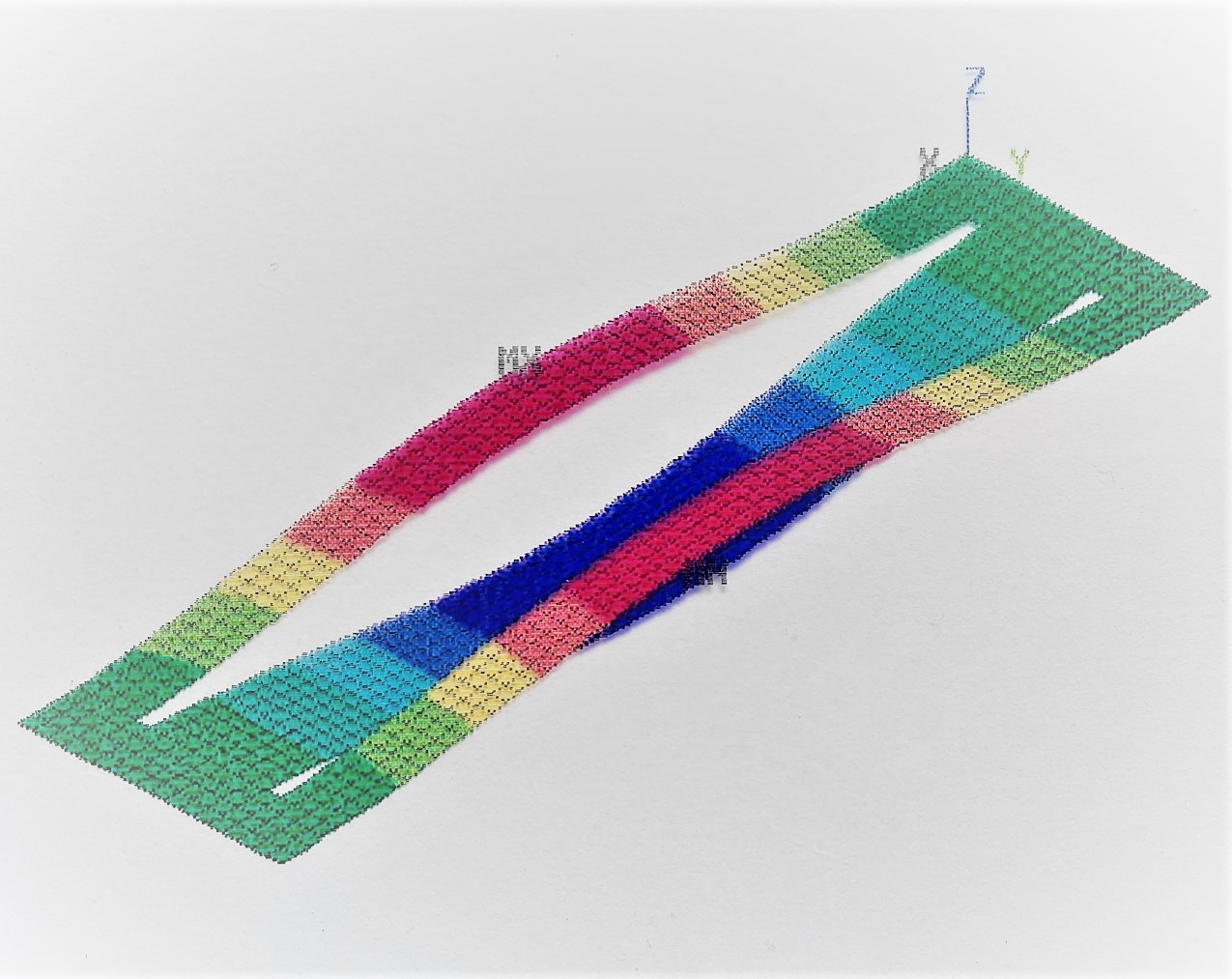
- For simple structures such as a micro-resonator, we can quickly estimate the desired operating range and the sensor’s characteristic curve using analytical models.
- For complex, coupled systems, we apply advanced numerical methods from mathematical approximation theory to deliver precise, reliable, and optimization-ready results.
This hybrid methodology significantly reduces development time and risk, while enabling you to reach market-ready designs faster and with higher confidence.
Analytical description
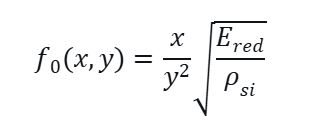
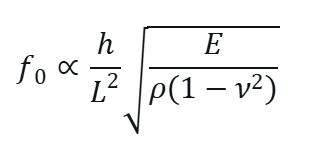
where:
- x = length of the resonator (m)
- y = thickness (or characteristic thickness) of the structure (m)
-
Ered ≈1.696×10¹¹ Pa (reduced modulus for silicon, plane stress approximation)
-
ρ(Si) ≈ 2330 kg/m3 (density of silicon)
General form
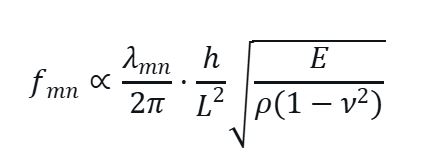 where: λ(mn) is a dimensionless coefficient that depends on the boundary conditions (clamped, free, simply supported, etc.) and the mode indices (m,n).
Geometric influence
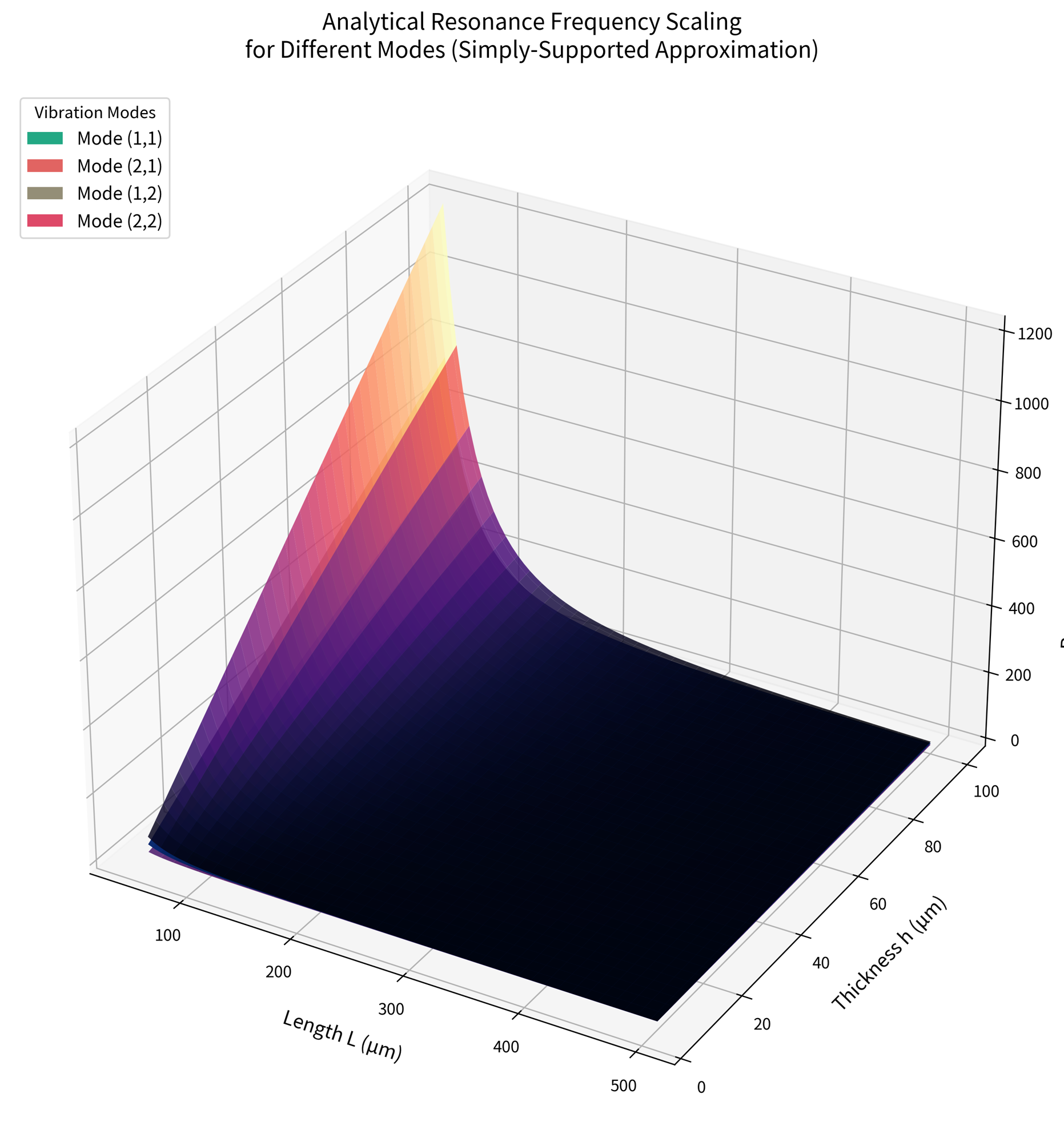
This formulation clearly shows the strong dependence of resonance frequency on geometry: linearly proportional to thickness and inversely proportional to length squared – a key insight for rapid design iteration of MEMS resonators.
Analytical Scaling
3D plot
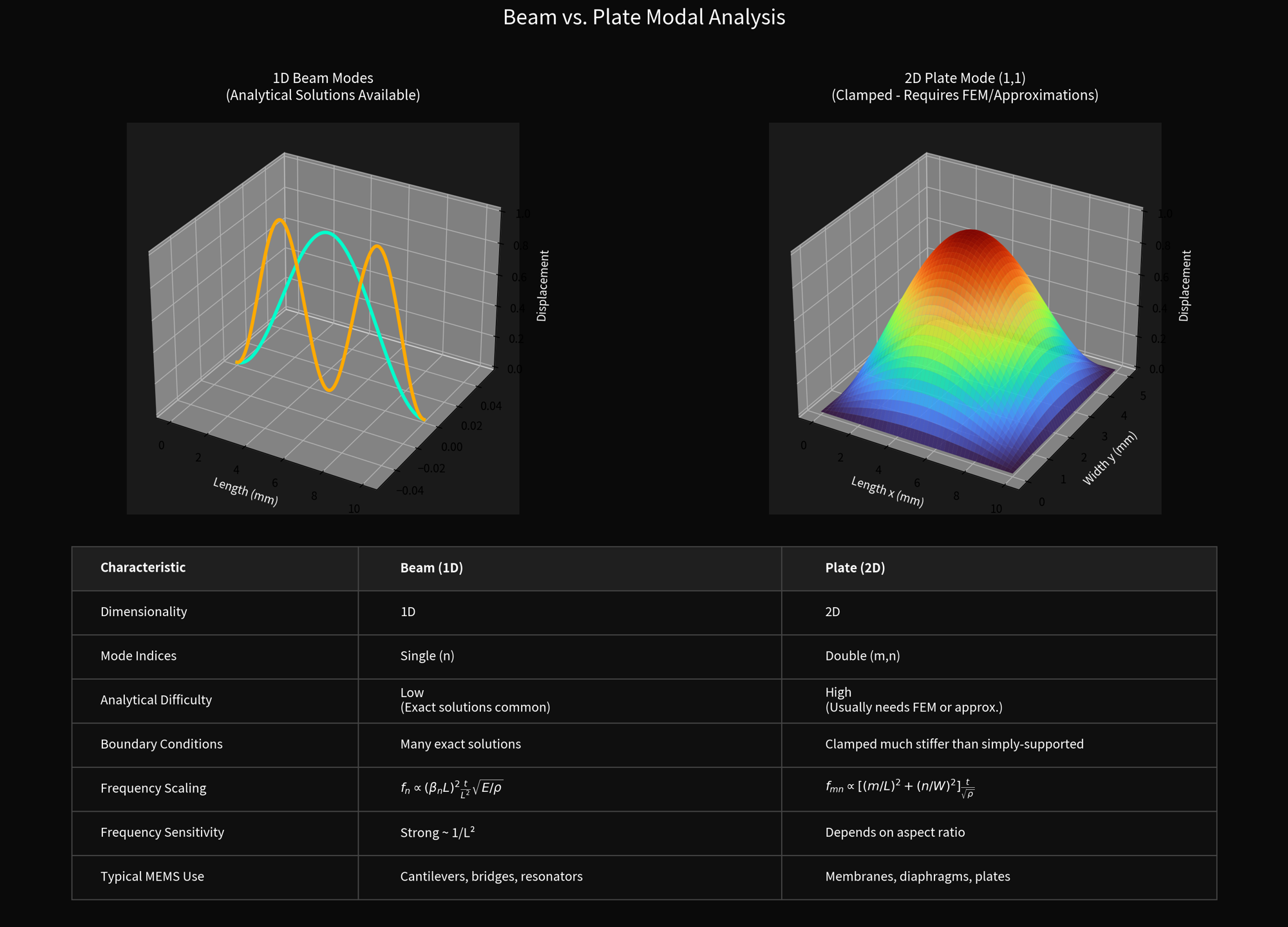
Modal Analysis
Beams (1D):
- Analytical solutions exist for many boundary conditions.
Plates (2D):
- More complex; often require numerical methods (like FEM) or approximations.
- Two indices (m,n) for vibration modes.
- Clamped boundaries increase frequencies significantly compared to simply-supported.
Mode Shapes
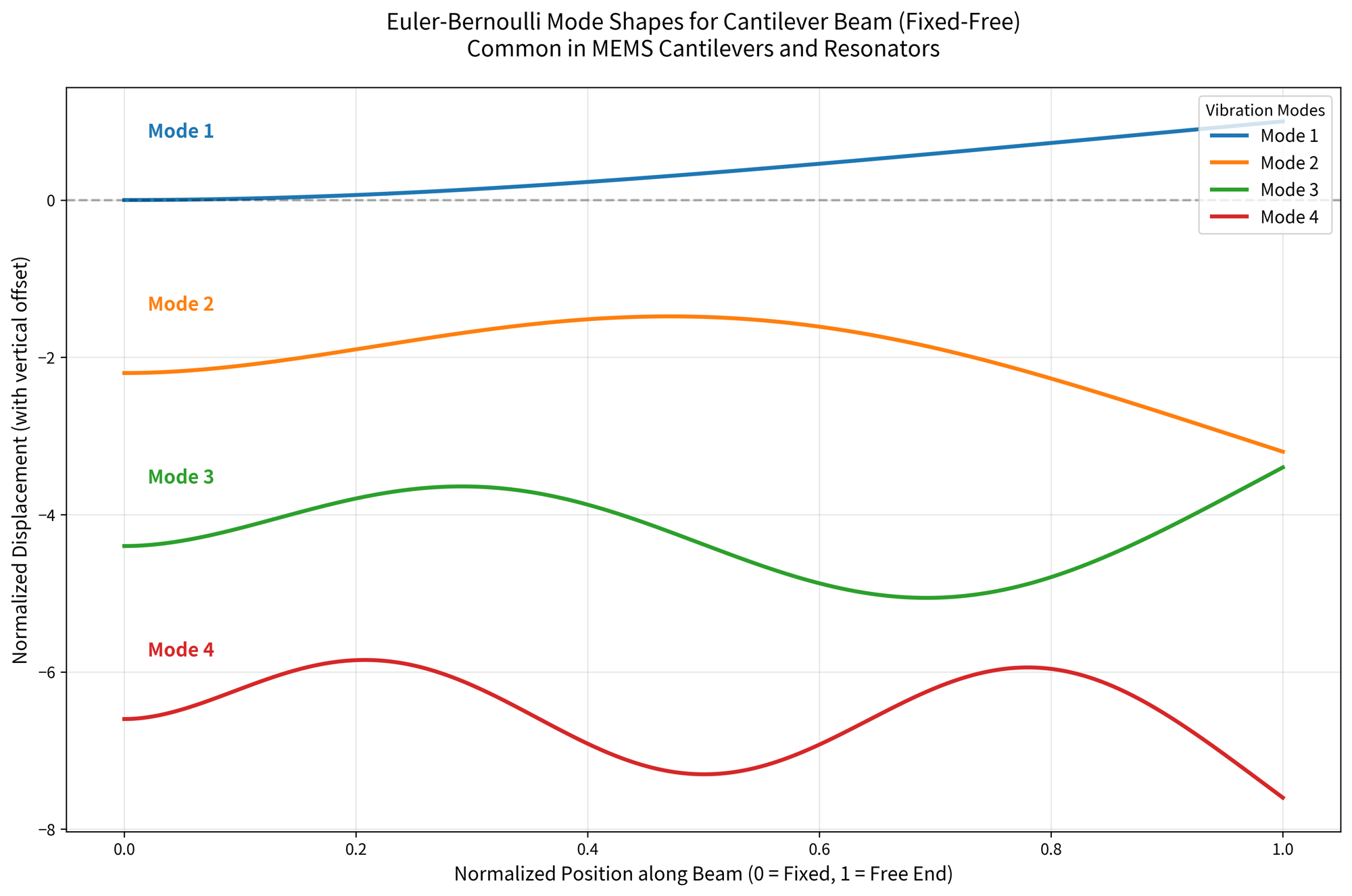
Features
- Mode 1: Fundamental bending mode (no nodes along the beam except at the fixed end).
- Mode 2–4: Higher-order modes with increasing number of nodes.
- Vertical offset applied for clarity.
These mode shapes are essential when designing resonators, as each mode has a significantly higher natural frequency (scaling roughly with the square of the eigenvalue βₙ).
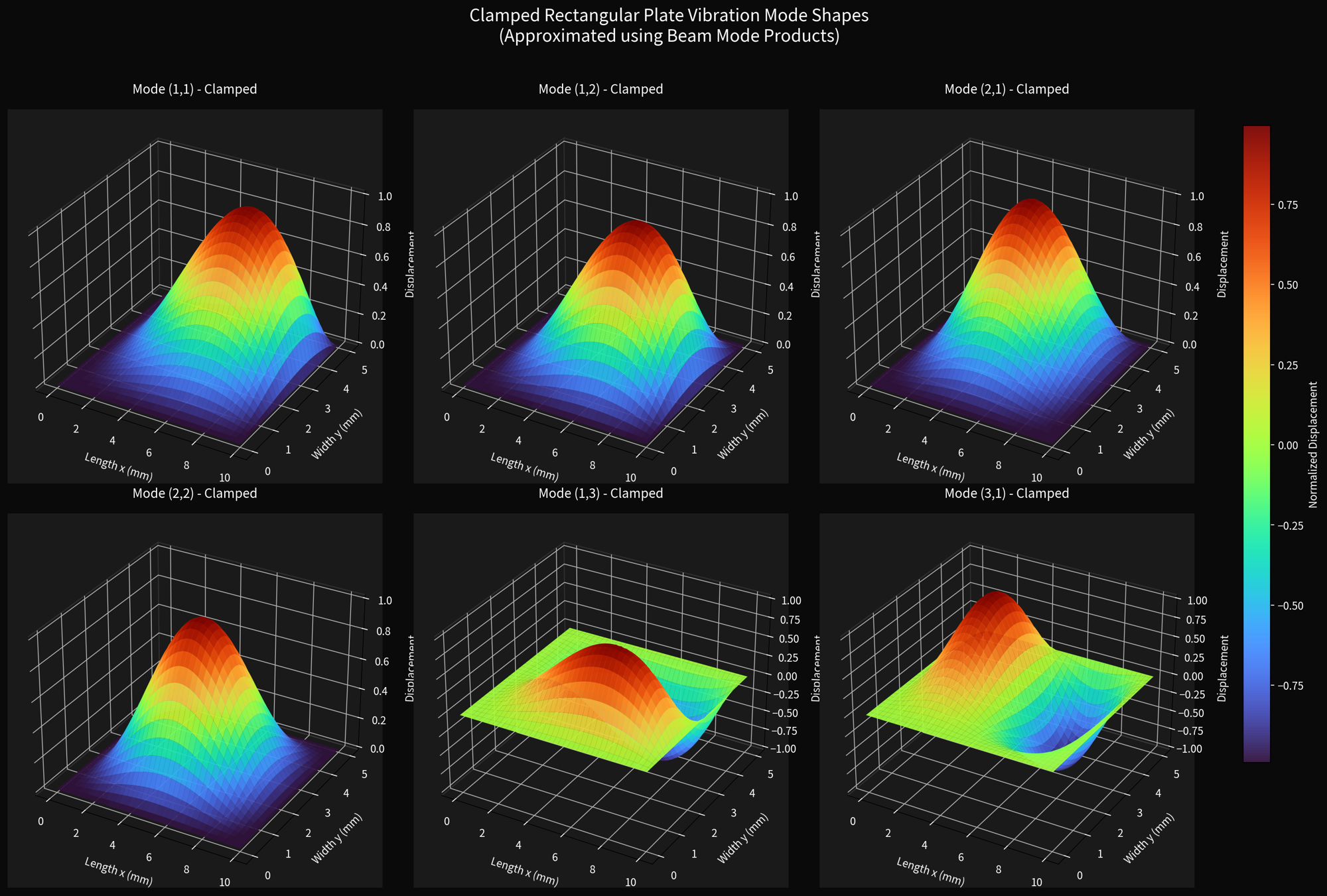
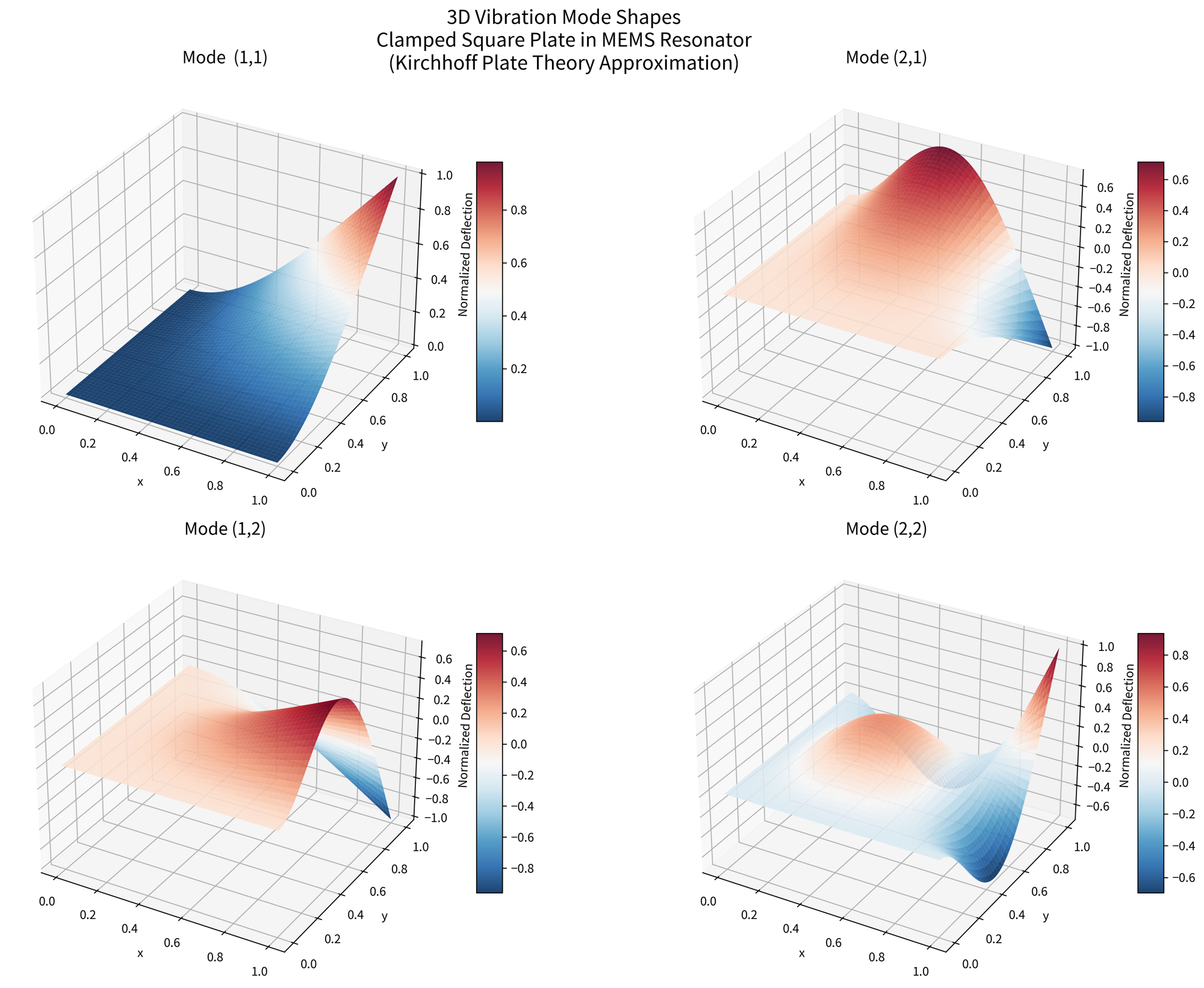
3D vibration mode shapes
- Mode (1,1) – Fundamental
- Mode (2,1)
- Mode (1,2)
- Mode (2,2)
Color scale: Red = upward displacement, Blue = downward displacement.
Micromechanical sensors
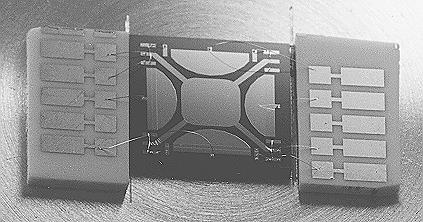
Analytical Modeling
Numerical Simulation
- Finite Element Method (FEM) – for structural mechanics, eigenfrequency analysis, stress/strain distribution, and mode shapes.
- Computational Fluid Dynamics (CFD) – for damping behavior, squeeze-film effects, or fluidic interactions.
This hybrid approach (analytical + numerical) enables TF Consulting to significantly reduce development time while delivering highly accurate performance predictions for MEMS resonant sensors.
Analytical modeling vs. FEM simulation
|
Aspect
|
Analytical Modeling
|
FEM Simulation
|
|---|---|---|
|
Best suited for
|
Simple geometries (beams, membranes, basic plates)
|
Complex 3D geometries, irregular shapes
|
|
Boundary conditions
|
Ideal / simple (fixed, free, simply-supported)
|
Arbitrary, mixed, or real-world clamping
|
|
Material behavior
|
Homogeneous, isotropic
|
Anisotropic, temperature-dependent, layered materials
|
|
Speed
|
Very fast (seconds)
|
Slower (minutes to hours)
|
|
Accuracy
|
High for ideal cases
|
High for complex real-world conditions
|
|
Multiphysics coupling
|
Limited
|
Excellent (thermo-mechanical, piezo-electric, fluid-structure, etc.)
|
|
Typical use cases
|
Quick frequency estimation, scaling laws, initial design optimization
|
Detailed mode shapes, stress analysis, damping, sensitivity, frequency drift
|
|
Computational resources
|
Negligible
|
Moderate to high
|
|
Insight into internal behavior
|
Good global parameters (e.g. f₀)
|
Full field results (stress/strain, temperature, deformation maps)
|
|
Development stage
|
Early concept & rapid iteration
|
Detailed design validation & optimization
|
Piezoelectric layers
Recommendation
- Start with analytical models for fast exploration and understanding of fundamental scaling laws.
- Switch to FEM + CFD for complex structures, multiphysics effects, and final performance validation.
This combination delivers both speed and accuracy – minimizing development time while ensuring reliable sensor performance.
Focus areas of our Services
Development & Implementation
We support you from the initial idea through the entire development process — including conceptual design, modeling, simulation, and successful implementation of microsystems technology within your organization. Our goal is to turn innovative concepts into reliable, manufacturable products.
Multiphysics Simulation
Cross-Industry Applications
We optimize MEMS components and microsystems for demanding sectors, including:
- Defence technology
- Automotive industry
- Internet of Things (IoT)
- Semiconductor and sensor technology
Our expertise helps clients in high-tech industries achieve competitive advantages through superior sensor and actuator solutions.
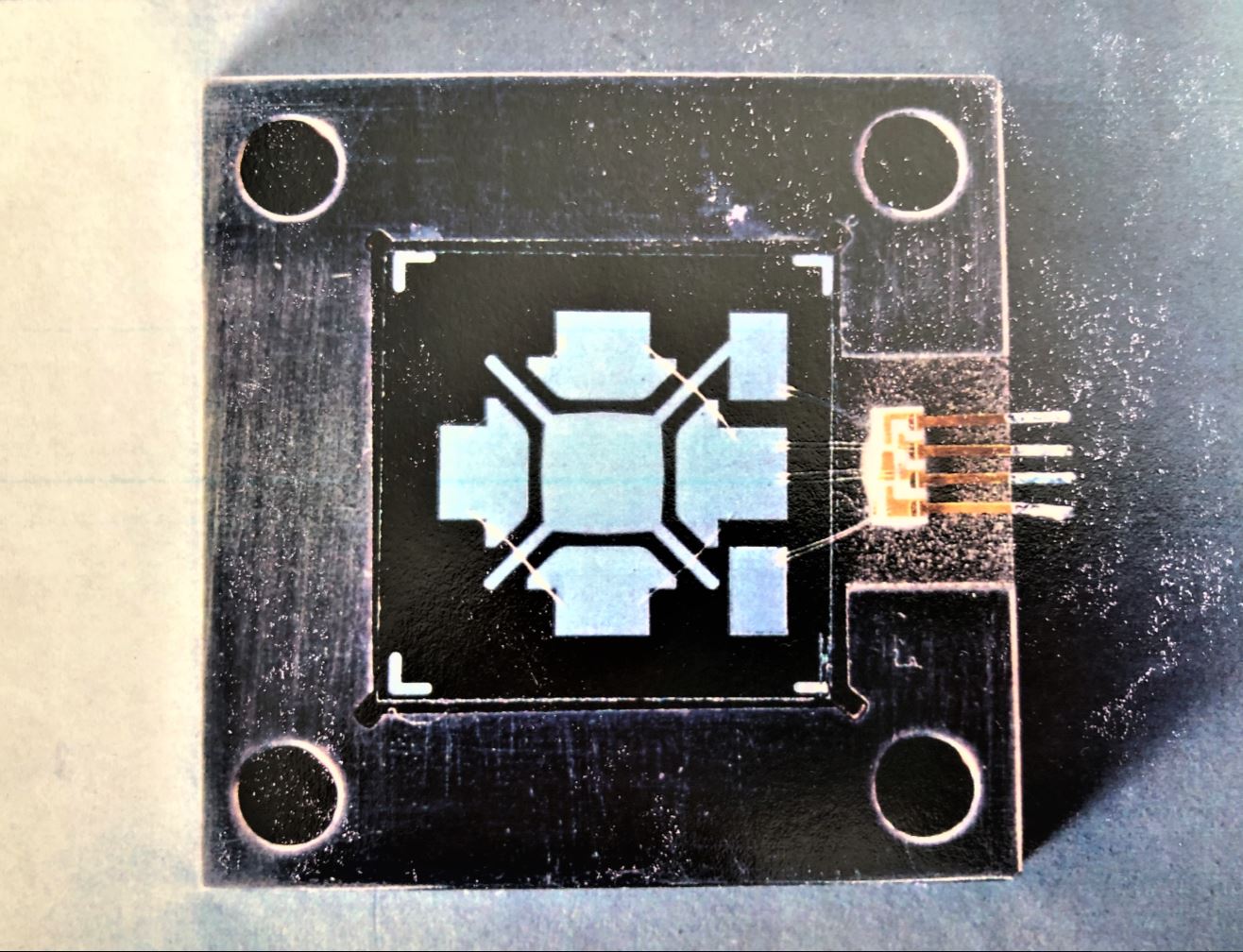
Analytical + Numerical Excellence
We follow a smart hybrid methodology:
- Analytical models for quick insights and fundamental understanding.
- High-fidelity FEM & CFD simulations for complex, real-world conditions and final validation.
This combination enables faster development cycles, lower prototyping costs, and superior product performance.
Our Approach: Analytical + Numerical Excellence: We combine the best of both worlds through our hybrid methodology.
GitHub Repositories
- github.com/ThomasFabula/BMFT_FASENS
- github.com/ThomasFabula/Quartz-DETF
- github.com/ThomasFabula/piezoelectric_simulation
- github.com/ThomasFabula/Modeling-of-Resonant-Silicon-Microsensors
Patent
Testimonial
Retrospective