Performance leaps in AI:
through processors or algorithms?
On the future of an AI-driven world – from an algorithmic perspective – Part 2
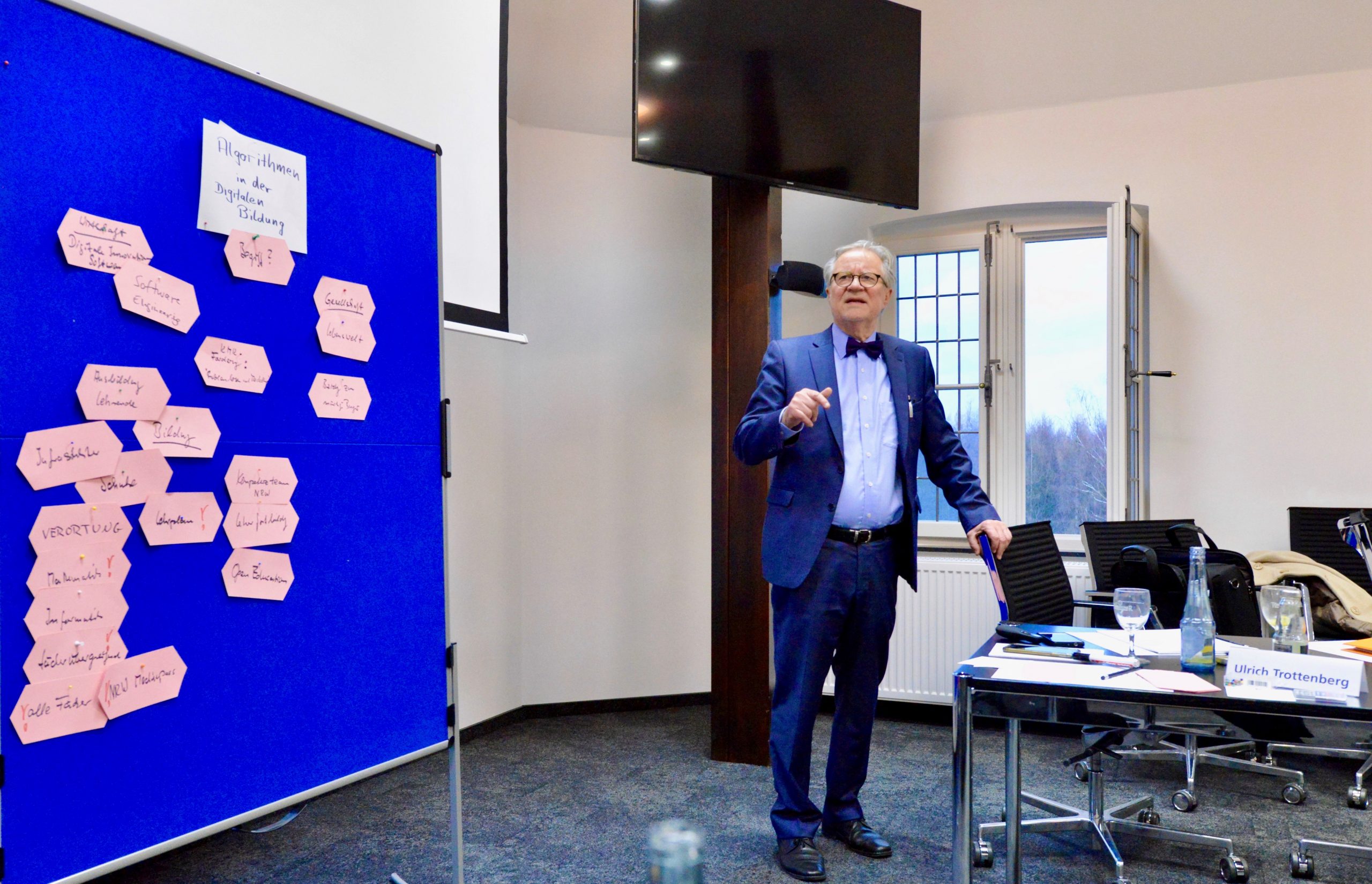
A dialogue
… between Univ.-Prof. (eremitus) Dr. Ulrich Trottenberg (UT) and Dr. habil. Bernhard Thomas (BT), June 2026 – Interscience-Akademie für Algorithmik (ISAfA).
AI is changing the world
UT: Artificial intelligence is fundamentally changing the world. This is particularly evident in the world of work – a large proportion of today’s jobs will disappear, and almost all professional groups will substantially alter their focus and priorities due to AI. With the major language models (LLMs like ChatGPT), which have only been around for a few years, many demanding areas of life are changing, such as education, journalism, and the legal profession. Alongside great achievements in fields like medicine and robotics, however,
… we cannot rule out potentially unpredictable and threatening developments.
BT: Of course, ultimately it is not “AI” but “humanity” that fundamentally changes the world with the possibilities of AI technology, for better or for worse. This also includes the possibility of transferring control over processes in the real world (instead of their digital representation) to AI systems (Agentic AI, Autonomous AI, World Models). And the concern is that humans will lose, neglect, or delegate the competence to control AI systems and their effects.
Anthropic is currently holding back its “Mythos” model, partly because it could be used to “independently” find security vulnerabilities in systems and launch cyberattacks . AI-enabled drones can autonomously decide on attack targets that fit the enemy profile or a strategic attack. Even autonomous driving cannot function without independent decisions from the embedded AI system.
The real question, therefore, is whether we can control the long-term impact of the global deployment of AI – or are we facing the same challenge as climate change ? And, in the lead-up to this, the question arises: who controls “AI,” and by what means? On a small scale, in the AI-generated development of novel, AI-based business applications, quality assurance and application security pose new challenges. On a larger scale, i.e., in the context of humanity, ethics, human rights, national interests, and conflict resolution, there are approaches to regulation (e.g., the EU AI Act), legal rules, measures to prevent misuse, and penalties, but these are far from providing a globally applicable answer to a global phenomenon. Today, the decision regarding the control of “AI” lies in many hands with differing interests: state or supranational organizations, the large tech corporations, and, above all, the AI companies themselves, which, based on their own understanding of the world of tomorrow, are further developing their (global) models. (The US government recently prompted Anthropic to block its Fable 5 model, a lightweight version of Mythos, from the non-US market.) So, who controls who controls “the AI”? Occasionally, “an AI” is brought into play here as well – as is already being tested on a “small scale” level.
AI applications are power–hungry
TU: Today’s applications of AI are extremely computationally intensive and consequently consume an enormous, indeed unacceptably large, amount of energy. In the USA, entire landscapes are currently being transformed to accommodate many thousands of AI data centers.
BT: A study from April 2025 ([1]) describes, for example, the currently largest AI-focused supercomputer, the ” Colossus ” by xAI (E. Musk), with 200,000 AI processors (GPUs) and a power consumption of 300 megawatts, equivalent to that of 250,000 households. The “Stargate Project” in Texas (OpenAI, Oracle) is developing a geographically distributed AI supercomputer infrastructure with hundreds of thousands of GPUs and a power consumption of 3 to 10 gigawatts. If current trends continue, AI systems with 2 million AI processors and 9 GW of power consumption are predicted for 2030. The current hardware trend also relies on specialized processors (ASICs, TPUs) and is limited by network speeds and ever-increasing energy demands. It is understandable that some companies are planning to meet their energy needs with local, modular nuclear power technology.
Intelligent solutions
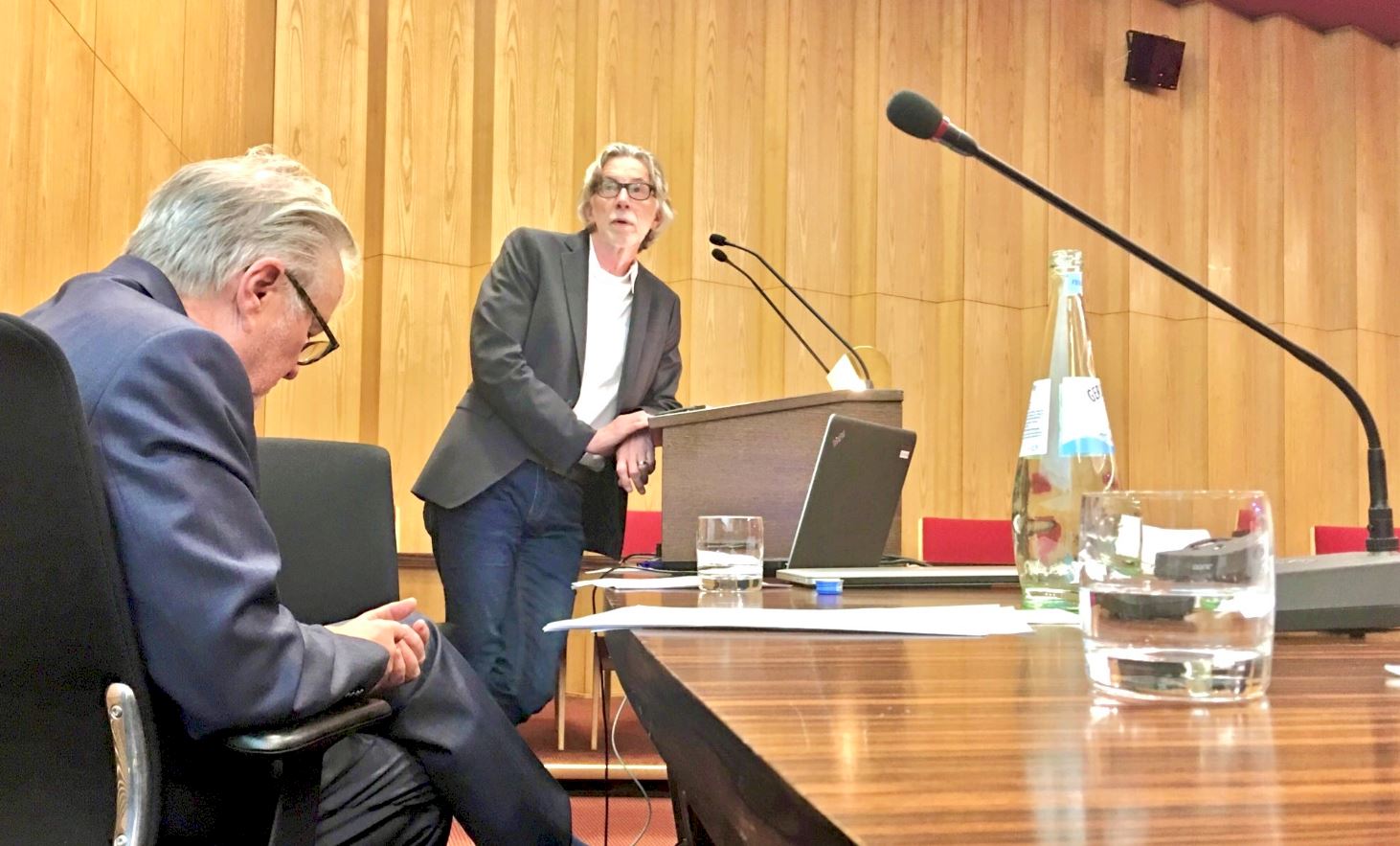
UT: Does it have to be this way, and – more importantly – does it have to stay this way? Must the world’s largest computers – with their millions of processor cores – be used, indeed, misused, for these (fundamentally quite simple mathematical) algorithms? Aren’t there other, more intelligent solutions?
They certainly exist! To illustrate this, we recall the story of young Gauss, who – as the story goes – was supposed to add the numbers from 1 to 100 at school. Instead of laboriously calculating 1+2+3+…, he rearranged the numbers: (1+100) + (2+99) + (3+98) +… and after a few seconds obtained the result 50•101=5050.
In doing so, he had replaced a slow, tedious algorithm (additions) with an intelligent (multiplication) algorithm, i.e., with a clever idea, and significantly reduced the computing time.
BT: From an algorithmic perspective, this replaces a method with a computational effort that increases linearly with the number n of summands (O(n)) with one with constant effort (O(c)) that leads to the same result. For Gauss, this means only two multiplications instead of 99 additions. These multiplications can also be easily calculated mentally – try doing the 76th addition in your head. From an efficiency standpoint, the effect of O(n) on O(c) is already astonishing. I tested it: On average, I needed 5 seconds for an addition on my calculator, assuming I didn’t make any typos, and the same for the two multiplications. So instead of 495 seconds, it only took 5 seconds. That’s an efficiency gain of approximately 100 times (10,000%).

High-performance AI
UT: Let’s not go quite that far, but back 85 years: The history of the first programmable, digital computers is closely linked to the name of Konrad Zuse and begins – after the predecessor models Z1 and Z2 – with the Z3 universal computer developed by Zuse in 1941. During this time, extensive algorithms were already being executed on the Z3, for example, matrix operations on a large scale. In the 1950s and 1960s, a multitude of computers were introduced (by companies including IBM, SEL, DEC, CDC, and Telefunken), and in the 1970s, Seymour Cray developed the first supercomputers (“Cray 1”). With “SUPRENUM,” Germany also developed its first parallel gigaflops (10^9) supercomputer for numerical applications in 1990. Today, we are dealing with computers of the exaflops class (i.e., 10^18 operations per second).
BT: Today’s supercomputers, specializing in AI operations, differ from “conventional” high-performance computers (HPCs) in their architecture, performance, and application. Huge clusters of specialized processors (GPUs, TPUs – T for Tensor) interconnected reach the zettaflops range (1021). Note: The flops comparison is flawed: HPC systems operate with 64-bit precision, while AI systems use 32, 16, or less.
The “growth in size” of AI hardware since 2020 shows a doubling of computing power roughly every 9 months, and of energy consumption roughly every 12 months, due to more efficient processors. Let’s disregard costs for now. This trend makes the forecasts for 2030 plausible.
Today, approximately 75% of all high-performance AI systems worldwide are located in the USA, 15% in China, Europe (approximately 4%), and other countries have only small shares. Germany has a strategic HPC system, “Jupiter,” in Jülich, which, as an AI supercomputer with around 24,000 GPUs, delivers 90 exaflops , or, as a 64-bit HPC system, approximately 1 exaflop . Its power consumption of around 18 megawatts is also modest compared to the “big players.” In contrast, the plans of other German companies (Telekom, Schwarz Digits) foresee significant increases.
Algorithmic intelligence
UT: Parallel to these hardware developments, the algorithms, i.e., the software, were also continuously improved, often resulting in significant performance leaps. For example, in the 1970s and 1980s, revolutionary, exponential performance improvements were achieved in the algorithms for specific matrix operations used to solve very large systems of equations.
To put it simply: Solving particularly important, very large systems of equations with n unknowns required only O(n) operations instead of O(n^2) operations with the new, intelligent ” multigrid ” algorithms. For n on the order of 1000 or 100,000, these optimizations thus achieved speedups of 1000-fold or 100,000-fold, respectively.
BT: When we talk about “intelligent” algorithms here, about intelligent ideas and solutions, we refer to the intelligence of mathematicians, computer scientists, developers, etc., who have developed new methods and faster, more efficient algorithms. This is in contrast to “learning” algorithms, which form the basis of AI (models). We have explained this in previous texts on “ algorithm change ” [2a, 2b].
With the current development of large, sometimes domain specific variants of generative models, “algorithmic intelligence” can certainly take on a broader meaning: Models with “algorithmic competence” can independently develop, propose, or support better, faster, and more innovative (i.e., “smarter”) algorithms as (virtual) team members. Practical experience strongly suggests this.

Better algorithmic intelligence
UT: As mentioned earlier, matrix operations play a central role in current AI algorithms, especially in large language models. This raises the question of whether more intelligent AI algorithms could achieve similar performance leaps as those seen with large systems of equations. This would have drastic practical consequences: instead of building computers that are, for example, 1000 times larger (faster), a factor of 1000 could be achieved through better algorithmic intelligence.
Of course, work on such fast algorithms is underway in many places around the world. For example, under the term “Flash Attention,” successful efforts are being made to reduce and accelerate memory accesses in large Transformer models. However, a widespread breakthrough apparently is still to be achieved.
BT: When we talk about algorithmic acceleration versus hardware performance, we need to clarify what is meant by “the algorithms” in AI in this context. Algorithms in AI appear on various levels:
- Hardware-related techniques (such as Flash Attention, parallelization at the processor level, memory optimization),
- Elementary mathematical-numerical operations such as matrix operations, function calculations (activation and loss functions, encodings), automatic differentiation (error backpropagation, gradient methods during training),
- Layers of the neural network structure (such as convolutions , LSTM, attention, noise/denoising ) , and
- Complete model structures (such as U- net , GAN, Transformer, Diffusion), which have been developed into an almost unmanageable zoo of variants, right up to the
- Combination or interplay of model structures (Knowledge Distillation , Teacher-Student, Mixture) of Experts , Quantization , BitNet ), in particular implementing structural differences between model training (complex, high effort, rare) and application (specialized, reduced effort, extremely frequent).
The greatest algorithmic effort (computational effort) arises in the numerical operations. Therefore, the question here is about faster methods, such as the multigrid method of the past.

You can’t touch a new algorithm
UT: However, when new, faster algorithms are developed, the public usually takes little or no notice. Generally, software always takes a backseat to hardware in terms of public interest. A new, large data center can be ceremoniously inaugurated; politicians and the press can be invited, and the data center managers can celebrate and be celebrated for having succeeded in acquiring many millions of dollars or euros to “procure,” i.e., purchase, the new data center.
A financial expenditure is being celebrated. (For example, the groundbreaking ceremony for the new Microsoft center in North Rhine-Westphalia.)
You can’t touch a new algorithm, however; who can truly understand the mathematical ideas it embodies? How can you celebrate an algorithm? Perhaps only by suddenly being able to solve problems that, before the introduction of intelligent algorithms, were considered unsolvable because they required an unacceptably large amount of computing time.
BT: … of algorithmic development in machine learning and generative AI has always been on the functionality, performance, and quality—let’s call it “competence”—of the models. What can the model do? With which model structures can we reliably train more or new capabilities? The models are becoming more complex, the parameter structures (weights) are growing immeasurably, and are only feasible through hardware scaling. Opening up (multi-modal) LLMs to the general public exponentially increases the demand for hardware power—and energy—compared to training the basic models. Consequently, other algorithmic goals have recently come into focus: reducing the effort while maintaining the same functional performance.
The core computational effort arises from the elementary mathematical operations (so). Here, one can “save” resources, for example, by reducing computational accuracy, such as by separating or specializing the application (inference) from the training phase of a model, or by dividing the process into sub-models that are trained on specific “competencies” instead of one large overall model. In agentic systems, tasks are distributed among a multitude of (potentially different) cooperating LLMs, i.e., harnessing algorithms at a “high level”.
The question is whether there are also algorithmic solutions at the elementary level that significantly reduce the computational effort. The multigrid methods mentioned above, which were developed, for example, for the numerical solution of partial differential equations, such as in weather forecasting (Trottenberg et al. [3]), serve as a model. In this case, the computational effort would grow not with the typical n2, but only with n, the number of grid points in physical models (so). In AI models, n would be, for example, the number of image pixels or the size of the so-called LLM context window.
And indeed, there are approaches or equivalents in AI model variants with a multigrid approach, even if they are not necessarily referred to as multigrid methods. An exception is MGNet , which in 2019 explicitly introduced MG concepts in CNNs (Convolutional Neural Network), i.e. hierarchically coarsening representation layers, is used [4].
The transfer of numerical machine learning methods to AI models is not immediately obvious due to the different problem areas. Firstly, numerical methods deal with solving large systems of equations, while AI models focus on optimizing or minimizing deviations (loss functions). Secondly, the “unknowns” in AI models are not the pixels or tokens, but the parameters (weights). The training data is comparable to the coefficients or the “right-hand sides” of a system of equations. But that’s a topic for another discussion.
Meanwhile, algorithmic variants exist that apply “coarsenal” at various points in the model structures, mostly in relation to the input data or error calculation (loss function). Interestingly, a major application of such multigrid neural methods is the solution of partial differential equations using machine learning. More efficient methods also exist for attention algorithms that grow with n2 (tokens). These approaches can reduce the computational effort from O(n2) to O(n*log(n)) or even O(n).
Nevertheless, one hears nothing in the public sphere about algorithmic advances, but all the more about new mammoth data centers and their power consumption.

New algorithmic ideas
UT: However, the term “algorithm” has entered everyday language over the last 20 years and is used frequently and even excessively by politicians and journalists. One can therefore hope and expect that significant progress will also be made on the software side through new algorithmic ideas. It should be noted, however, that the traditional clear separation between hardware and software no longer plays the same role with the new, high-speed processors as it did with traditional computers: hardware and software are, for example, jointly developed and optimized in “hardware-software co-design .”
Despite these promising developments, research into intelligent AI algorithms should be further intensified and supported with more generous funding.
BT: In the media and public discourse, performance of new large processor farms are now being characterized not in terms of FLOPS and bytes, but rather by their power consumption , for example in gigawatts. This implies: the more gigawatts provided, the more computing power is available for AI. It’s high time that, alongside cost efficiency (dollars per FLOPS), energy efficiency (e.g., watts per token) is taken into account as a system parameter. The latter can be significantly influenced by the algorithms.
Statement
Intelligent, fast AI algorithms are far preferable to an army of data centers that consume an enormous amount of energy and inevitably become obsolete and need to be replaced at some point.
Acknowledgements
*) This statement is based on research using Gemini and has not, in our view, been verified in detail.
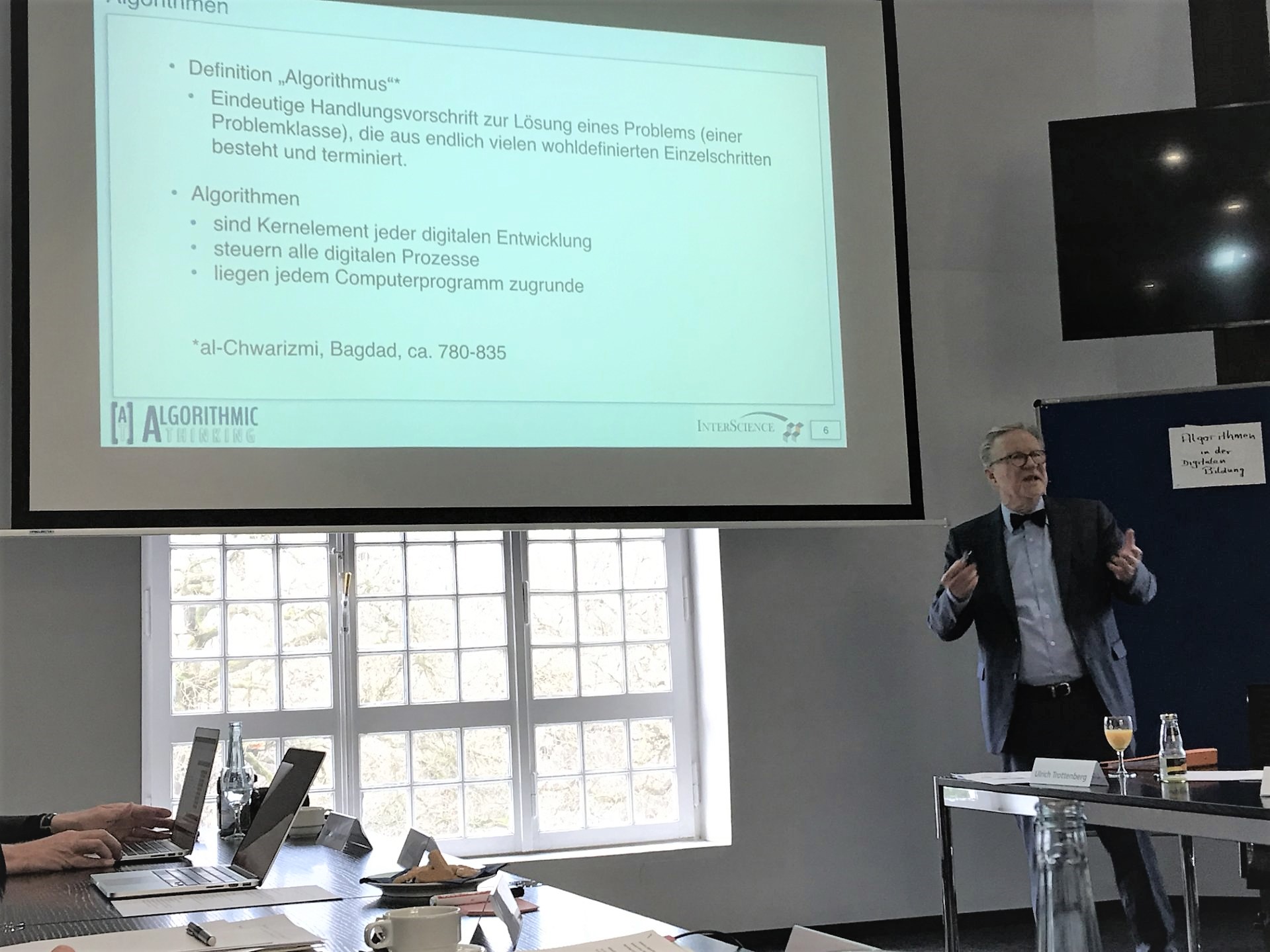
Note: These texts are handcrafted and not edited by LLMs. Therefore, any errors or awkward phrasing are our responsibility. For more in-depth research or when explanations were needed, one of us (BT) used Gemini 3.1 Pro (free). For safety, we verified the information using original sources, including those listed below. Much of the content is also based on long-term learning, experience gained through conversations and practical application, and reading, though we cannot explicitly cite the origins.
Further information
InterScience Akademie für Algorithmik GmbH, Cologne

Dialog: Leistungssprünge in der KI – Prozessoren oder Algorithmen?
Source references
- [1] Pilz, KF et al.: Trends in AI Supercomputing , April 2025, arxiv.org/abs/2504.16026
- [ 2a] Trottenberg , U: Algorithm Change , February 2022,
interscience-akademie.de/2022/02/19/algorithmenwandel/ - [2b] Thomas, B: Algorithm Change – What’s Behind It?, September 2023,
interscience-akademie.de/2023/09/01/algorithmenwandel-was-steckt-dahinter/ - [3] Trottenberg, U et al.: Multigrid, Academic Press, 2001
- [4] He, J and Xu, J: MgNet : A Unified Framework of Multigrid and Convolutional Neural Network, May 2019, arxiv.org/abs/1901.10415v2